
Issue #28: The New New "Learn to Code"


This week, a look at some recently funded EdTech products, everything is still Private Equity, and a Day in the Life of an Enshittificator. Onwards.
Five Links:
News: “Train the world on AI” is the new “Learn to code”
UK-based AI training startup Calibr recently raised an equity financing round from BGF to expand its platform helping businesses upskill teams in artificial intelligence using government funding. They raised money to “train the world on AI”. Nice and vague.
Calibr appears to be the next startup for Peter Wood and Marlene Leiss. The pair previously founded The Graduate Guide which was acquired by Apprentify at the end of 2025.
It looks like they host in-person discovery days where businesses can meet “pre-selected talent” (read: people), watch them solve “real operational challenges” (read: job stuff) and interview them.
Alongside hiring, they also upskill existing teams in AI and automation to “alleviate routine work so they can focus on indistinguishably human tasks”. That adjective is doing a lot of heavy-lifting.
News: It’s cheaper than ever to build a skills-based course
Kyiv-based B2C edtech platform Kodree has secured $10m in funding from PvX Partners to expand its “AI-powered learning platform” that helps users develop in-demand skills like Python, Figma Basics and Vibe Coding. They do this with online learning supported by an AI assistant.
I’m seeing more and more bootcamps pivot in this direction. Increasingly it’s by reducing instructor headcount and having AI play the guiding role.
Kodree isn’t claiming you will get a job going this route. But it does claim you will learn “in-demand skills”. Pricing has collapsed for this type of product. Kodree is doing $150 for lifetime access. A few years ago this course would have cost $1500+. Scale is the key here. Removing humans from the process helps.
News: Replit introduces Agent 4 as Stitch alternative
Replit has a new product that competes with Google Stitch. It’s called Agent 4 because AI companies still refuse to think about naming conventions.
As Peter Yang notes, most AI coding agents are heading in a similar direction. Instead of pair programming with one agent, you’re managing a team of agents. You give them instructions, step away, and come back to review the work.
It’s also clear the AI coding market is splitting in two: technical and non-technical. Claude and Codex dominate the coding market but the non-technical one is more fractured. Replit is betting design and development happen in the same app. And that integration across the Google / Microsoft suite is a competitive edge.
If you are designing learning products, this full-cycle approach is the direction of travel.
New Product: Wondering, a “Duolingo for Everything”
Founded by an ex-Google software engineer, Wondering describes itself as “Duolingo for Everything”, letting you turn any topic into a guided path with bite-size visual lessons that can fit into your busy schedule. We’re all, always, “so busy”.
Duolingo for Everything is…not the best tagline. But I downloaded it this week and have been playing around with it. It has a nice simple UI that aims to circumvent AI “brain fry”. It prompts you to select your job title on signup, and tailors recommendations based on that. I’ve been using it to understand concepts from non-fiction books. Unlike Blinkist, it engages the active rather than passive part of your brain. One to keep an eye on.
Watch: A Day in the Life of an Ensh*ttificator - YouTube
This is the best government-sponsored ad you will see this year. God I love Norway.
One more thing.
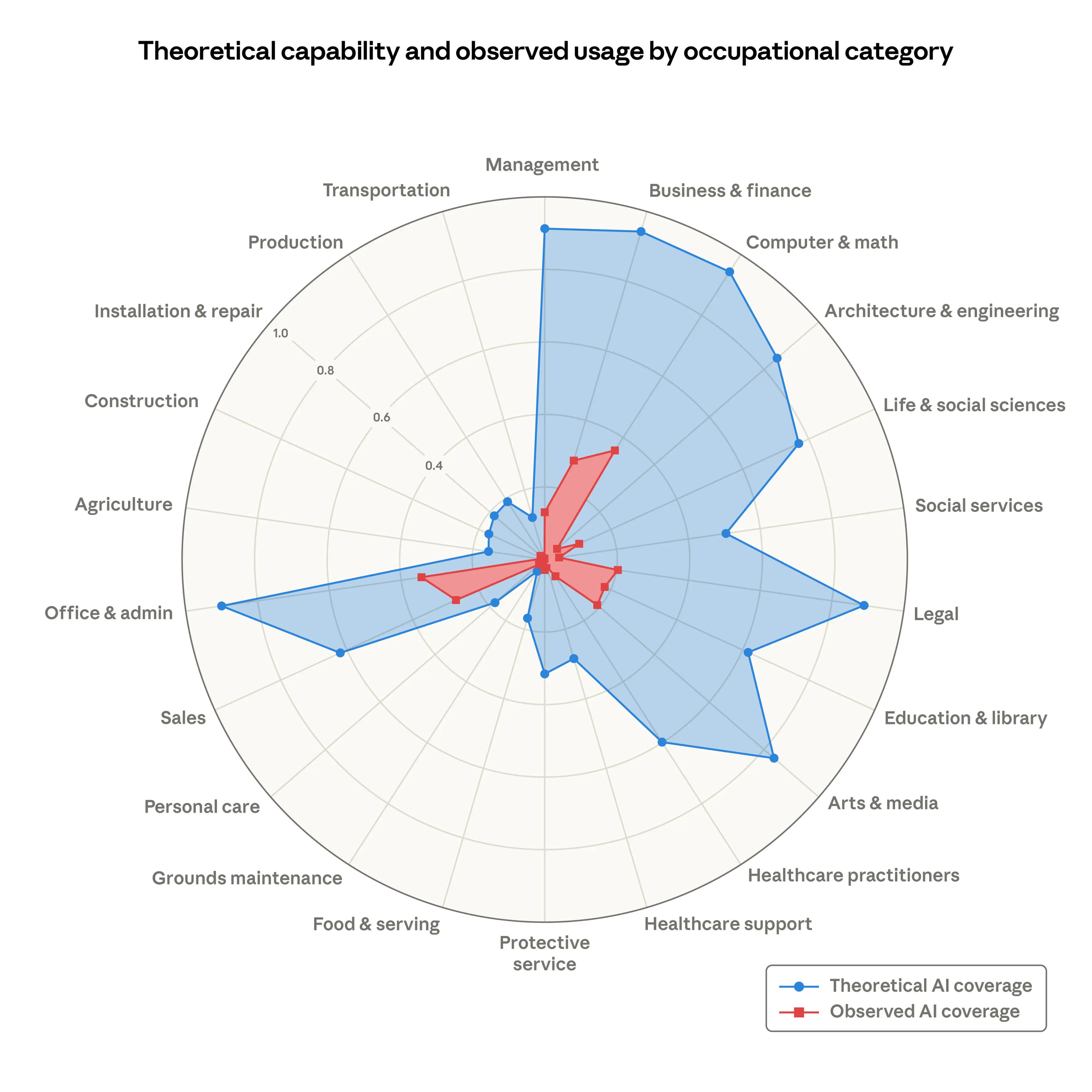
Earlier this month, Anthropic published a report mapping which jobs are most exposed to AI.
You’ve probably seen this image from the report.
Source: Anthropic
The authors rank education among the more exposed sectors. Their example: AI can grade homework but it can’t manage a classroom.
I guess in this future world the authors envisage that we will all have personal AI tutors in our pockets.. But I just don’t see the accountability and community aspect of learning being replicated online anytime soon.
Teaching, particularly for adults, isn’t delivering content, then grading. It’s interpreting deliberately standards and figuring out what “managing stakeholders” looks like for a 19-year-old at a SaaS startup versus a 35-year-old career changer at an NHS trust.
None of this appears in a task-based framework because none of it is a task. It’s judgment, negotiation, and working with real people. Work that happens in the gaps between the things that look like tasks.
The report is well put together. The methodology is interesting. But I can’t imagine any of the authors have been in a classroom since they were at school. Reducing education to “grading homework” and “managing a classroom” ignores the myriad other personal touches that encompass teaching.
There is some relief, though, buried in the report. Particularly if you’re worried about AI replacing your job.
The authors say:
“We find no systematic increase in unemployment for highly exposed workers since late 2022, though we find suggestive evidence that hiring of younger workers has slowed in exposed occupations.”
This perhaps reflects what we’re seeing with software developer jobs. One of the sectors the authors say will be most disrupted is “Computer & Math” i.e. software development jobs.
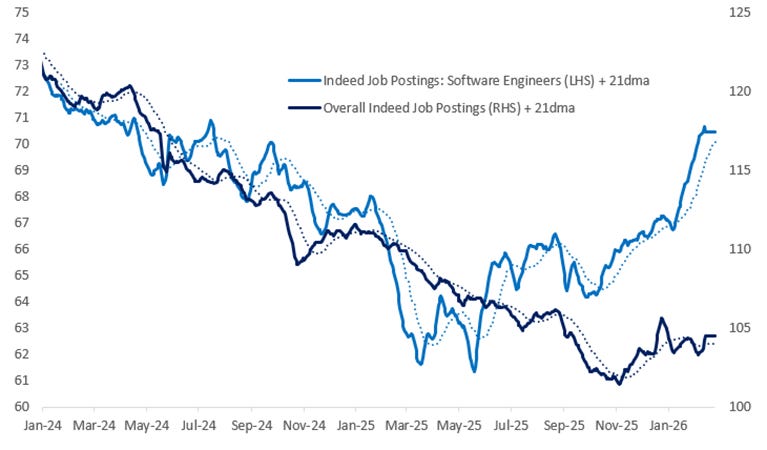
But a recent report from Citadel Securities claims job postings for software developers are actually increasing. Sure, the market for junior developers is probably bad, but we’ve had a decade-long run of coding bootcamps and universities pumping out CS degrees after the “learn to code” boondoggle. Maybe the market is just over-saturated from training?
Source: Citadel Securities
In other words, the evidence of labor disruption is weak. You would think there would have been some signal in the data if widespread job losses were going to happen. Yes I know these models are progressing at an exponential rate blah blah blah. But are the doomsday prognoses just there to justify valuations?
Also this week. Some jobs that might be of interest.
Senior Online Course Manager, Raspberry Pi (£58k-64k p/a) Cambridge / Remote.
Raspberry Pi are looking for someone to develop the long-term plan for their online courses. Bit of management and travel with this one.
Senior Programme Learning Designer, Multiverse, London.
Multiverse are looking for a Learning Designer and 41 other roles. MV always be hiring.
Director, Learning & Development - Certifications & Platform, Walmart, New York.
Walmart want someone with 10+ years’ experience to ensure learning programs and platforms are scalable, data-driven, and business-aligned, transforming learning into a competitive advantage for Walmart Connect. Up to $264k for this one.